
Sociologist Paul Sullins Growing up with same-sex parents has several negative consequences for children
Children with same-sex parents suffer more emotional problems than those of opposite-sex parents, sociologist says.
Vypočuť článok
Sociologist Paul Sullins / Growing up with same-sex parents has several negative consequences for children
Najčítanejšie
Deň
Týždeň
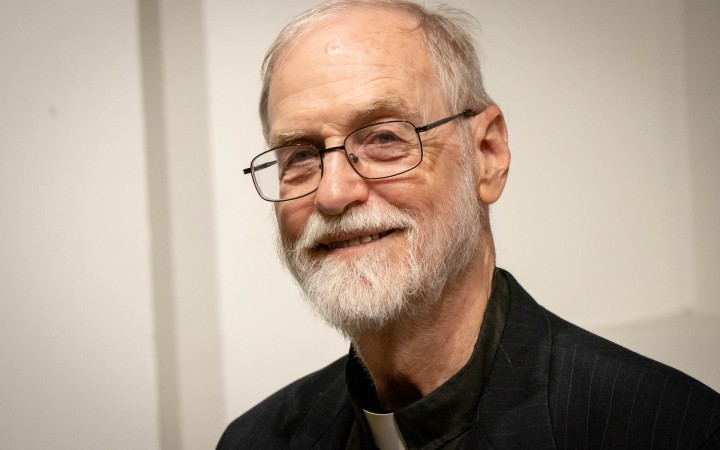
Donald Paul Sullins is a sociologist and statistical researcher who worked for twenty years at the Catholic University of America in Washington, D.C. He is engaged in sociological research and serves as a priest. As a married Episcopal pastor and father of a family, he converted to the Catholic faith.
He visited Bratislava, Slovakia, at the invitation of the Ladislav Hanus Institute and gave a lecture on Dispelling Woke Myths about Sex as part of the Conservative Forum format.
In the interview he discusses what are the main differences between opposite-sex and same-sex relationships, how it affects children when they have same-sex parents or whether it is true that homosexuality is innate and unchangeable.
We also talked about what may be behind the sharp rise in transsexual self-identification or whether paedophilia is really behind the sex scandals in the Catholic Church.
Paul Sullins’ presentation and the research studies cited in it can be found in full at this link. They are free to share.
Tento článok je anglickou verziou rozhovoru, ktorý si môžete v slovenčine prečítať na tomto odkaze.
What are the main differences between opposite-sex and same-sex relationships?
The main difference between them is the possibility of children. Opposite-sex relationships always carry the “risk” of children. You could also call it the promise of children. And so the relationship has to be oriented to that reality. When a child comes, it’s important to have stable parents who are going to love that child until their maturity and hopefully for their whole life.
The self-sacrifice and self-giving between the potential mother and father are also important before when the child comes. So there is that ordering towards a child. There is not that ordering in same-sex relationships. This shows up in very practical and empirical ways in research.
One way it shows is that opposite-sex relationships tend to be much more stable than same-sex relationships. There is a much higher rate of breakup among same-sex couples. It is higher for lesbians than it is for men; lesbians dissolve their relationship at a much higher rate. That makes sense because as you may know, two thirds of heterosexual divorces are initiated by the woman. So if you have two women together, this probability increases further.
The difference is also in rates of fidelity. In same-sex relationships, fidelity is much lower than in opposite-sex relationships. For example, gay male relationship including gay male marriages don’t come with expectation of fidelity, in fact, they come with the opposite expectations. They want to be free to have sex outside the relationship under certain conditions.
About 40% of married gay male couples, that we know of, have agreements on under what conditions they can have sex outside the relationship. The most common agreement – and this is the basis on which gay male couples claim fidelity – is that you can have sex outside the relationship so long as you are not emotionally involved to that partner. So that it is just sex for recreation.
There is also infidelity and instability in opposite-sex relationships. However, when a child comes to that relationship, opposite-sex relationships become ever more stable than they were before – the commitment for marriage increase. For the same-sex relationships it is exactly the opposite – they become less stable when a child comes.
Why is that?
When a child is produced from an opposite-sex relationship, both parents have an investment in that child, we call it a genetic investment. That child reflects the biological and genetic reality of both parents. Each of the two can see themselves in the child and it helps them bind them together.
With same-sex parents, there is not that common bond with the child, there is not the same dynamic. So when a child comes, it has an asymmetrical relationship with the two parents.
Lesbians are four times more likely to be raising children than gay males. And lesbians increasingly procreate their children by artificial means. Think about what happens when you are a lesbian couple and you say you want a child – it is called planned lesbian parenting. If they choose to have the child biologically, they have to decide which one of them is going to carry the child and be the biological mother.
The child comes and what happens is the dynamics of that relationship change. The biological mother is focused on, loving and relating with this biological child – and the social mother starts to feel left out.
In other words, the tensions caused by same-sex parents’ different modalities of love for that child, the different levels of connection with it, can put strain and stress on that relationship and sometimes can tear it apart. This kind of asymmetrical stress due to different biological connections to the child can never happen with man/woman parents.
What are the main risks for a child when being adopted by a same-sex couple?
The most important principle in adoption is to make decisions that are in the best interest of the child. This is established in an international law and almost every national law. So when you’re deciding where to place that child, the first and most important consideration has to be: what’s the best for that child.
In response to that, adoption strategy usually involves placing that child with parents that are as much like that child as possible, where there’s as much affinity. So in the United States for example, it can be done, but it’s rare to place an African-American child with a Caucasian family. They would prefer to place that African-American child with an African-American family where they would look like and feel like they’re part of that family, part of the same background.
One thing we know about children is that statistically somewhere between 98 and 99% of those children are going to be heterosexually attracted children. One to two percent may develop same-sex attraction. So if you have a choice in placing that child with a heterosexual set of parents or a homosexual set of parents, for the best interest of a child, you would want to choose the heterosexual parents. So that you have a heterosexual child growing up with heterosexual parents, not that you have a heterosexual child growing up with homosexual parents. In general, that’s not in the best interest of the child.

Photo: Postoj/Jakub Lipták
In your lecture you were talking about results of various studies showing that children growing up with same-sex parents show higher risk of emotional damage. Could you sum up what the main risks are?
We know that transience is much higher with same-sex parents. When parents dissolve their relationship, children tend to be emotionally harmed. Same-sex relationships tend to involve greater intimate partner violence which doesn’t resolve in positive outcomes for the children.
Children with same-sex parents are more prone to abuse: emotional, physical and sexual. I looked at this question myself and I found that over 90% of children with same-sex parents suffer one of those three forms of abuse. That’s a very common experience that will lead to negative child outcomes in those relationships.
In my study I have found that while 7.4% of children with opposite-sex parents have serious emotional problems, this number grows to 17.4% in case of children who have same-sex parents. Children with same-sex parents have also higher rate of ADHD and receive medical treatment for a serious emotional problem three times as much often as in the case of children who have opposite-sex parents. The difference is also visible when we compare children with same-sex married stepparents with opposite-sex married stepparents – in the first group, children have twice the chance of suffering emotional problems than in the second group.
The claim that children who have same-sex parents turn out as well as children with opposite-sex parents is simply false. They do not turn out as well. This of course does not mean that every child who grows up with same-sex parents is automatically spoiled somehow.
Does it make difference whether a child is raised by two mothers or by two fathers?
First of all, the fact that same-sex parents could be either two men or two women adds another dimension which we must factor in.
With opposite-sex parents it always a man and a woman who raise either a boy or a girl, so that’s two cases. In same-sex parents we have four cases: two men raising a boy, two man raising a girl, two women raising a boy and two women raising a girl. When people talk about the outcomes for children with same-sex parents they just lump all these four cases together as it was the one thing.
In my analysis I found that the outcomes are very different depending on what is the child-parents setting. Boys being raised by two male parents have four times the risk of emotional problems compared to children with heterosexual parents. However, boys being raised by two women this rate drops down to 2.6 times higher risk of emotional problems.
It’s exactly the opposite for girls. If they are raised by two male gay parents, they have two times the risk of emotional problems (compared to children with heterosexual parents) but if they are raised by two lesbian parents it goes up to five times the risk. These comparisons are tentative and need more research.

Photo: Postoj/Jakub Lipták
Very common question is: aren’t all these negative outcomes caused by people’s prejudices towards these children, e.g. bullying in school, discrimination?
This is called minority stress theory – it says that social stress and discrimination is the primary if not sole cause of higher rates of difficulties for sexual minority people.
That theory has failed to be convincing on a number of levels. There is in many cases a correlation between discrimination and higher difficulties but it’s not clear whether the persons suffer more discrimination because they have the difficulties already or whether the discrimination somehow causes the difficulties.
Today it’s common to talk about perceived discrimination rather than real discrimination against sexual minority people because there’s a real probability that same-sex attracted people see themselves as being discriminated against more when in fact they may not be.
Some other ways this is shown up is the rate of suicide attempts by young sexual minority persons which has been increasing since the 1970’s. Today about 30% of sexual minority persons under the age of 30 report that they have attempted suicide. Back in the 1970’s that was less than 15%, so that has more than doubled. These are not my numbers, they were reported by Ilan Meyer, the main pro-LGBT proponent of minority stress theory.
Well, discrimination, stigmatisation of sexual minority people has not increased since the 1970’s. In most areas of the world it has dramatically declined. So here you have a situation where you have a declining minority stress but you have an increasing suicide attempts. That runs directly contrary to the theory of minority stress.
If minority stress was the cause of the difficulties of same-sex attracted persons, in more discriminatory and stigmatising societies you would have more stress, more psychological difficulties, more suicide attempts than in more tolerant societies.
But if you compare let’s say the Netherlands with the southern United States – the Netherlands is very tolerant and the southern United States has higher levels of discrimination – you find that the rates of psychological distress and of suiciadality for LGBT people are almost identical in those two environments. So that seems to suggest that it’s something other than discrimination and stress that are causing these difficulties.
In last decades we see sharp increase self-identification as being homosexual or transsexual. What is your idea why this happens?
I think there has been a very successful push towards the normalisation of being homosexual. That it is something acceptable, maybe even desirable. A lot of young people seem to adopt that identity almost by social pressure or because it’s cool.
You can also say that as lower discrimination and stigmatisation has occurred in most settings that same-sex attracted persons, who formerly wouldn’t reveal that, now feel freer to reveal that. So it may be that they are making themselves known to a greater extent than before.
But what I expect to see is also a greater defection rate from same-sex orientation. Among the young there is this rise in identification as sexual minority. It’s not so much among persons aged 50 or over. But twenty years from now I expect to see teenagers who are coming out as gay now, they may be defecting at a higher rate than we see the defections now.
However, some say that sexual orientation is something you cannot change. Is it true?
No, that is not true. Sexual orientation does change. The most prevalent pattern is to desist from minority sexual orientation – and not to persist in it.
For most persons who have a minority sexual orientation, they change their orientation at a later point in their life. So they might not be completely heterosexual but they’re moving in a heterosexual direction for the most part. So they have only same-sex sex and then a later time in their life they would have both same-sex sex and opposite-sex sex or they would have sex with only the opposite sex.
So how could that be if it wasn’t changeable? In fact, it’s not only changeable, it usually changes for most sexual minority people. It may or may not involve therapy to do that, but desistance is quite common. That seems to suggest to me that sexual orientation is not innate, is not genetic. A true genetic condition generally doesn’t reverse itself of change during life. If a man goes bald – male pattern baldness – in his forties, the hair usually doesn’t grow back. It’s a chronic change.
Careful genetic research, both in twins and using genome sequencing, have concluded that the claim of a “gay gene” is a myth.
Do we actually know what homosexuality is?
No, there are a lot of theories about what it is. We may be reifying a set of behaviours and tendencies that are really just a bundle of reactions to heterosexuality that can’t be really easily put into a group and called something of their own.

Photo: Postoj/Jakub Lipták
Let’s talk about transsexuality. It seems there is a very sharp increase in self-identifying as such – mostly in young girls. Is it just a fad or is it something more?
Nobody knows for sure. It was an unusual phenomenon. The number of young women applying for transsexual treatment of some sort increased by something like a thousand percent in five years. So it seems to be something like a social contagion, maybe an Internet of media phenomenon that is not totally well understood.
I don’t want to use the word fad – it’s a little too serious to call it a fad, but it has that characteristics. And I myself couldn’t tell you why it has occurred that way, but the idea that these young women who are reporting this, were rushed into it – it seems with very little scrutiny –, were moved into receiving hormones and then having surgery that would remove their breasts, surgically alter their genital area, just seems way out of line with the phenomenon that occurs.
What do data tell us whether it is better to reaffirm these people in their transsexuality or rather wait and see what happens?
I think the wisdom that is swiftly being established is that we should wait, we should engage in watchful waiting. Doctor Kenneth Zucker recommended that back in the 1990’s and he was deposed by the transsexual advocates. He lost his job, they tried to silence him. He sued the university, won a big financial settlement and his reputation was restored.
He didn’t get his job back but he has written, repeatedly since then, about the benefits of engaging in watchful waiting, providing appropriate psychiatric aid not only to the child, but to the whole family, so that they can grow out of this. And he has found that by doing this he had almost 90% success rate in resolving these cases without resorting to surgery. It just seems crazy that people would ignore this kind of success and move on to surgical options when they don’t seem to be necessary.
Is it true that by reaffirming the gender of the transsexual-identifying young person we lower their chance for a suicide attempt?
It may temporarily lower them, but in the long run it dramatically increases their chance for a suicide. You put that young person in a state where they are very likely not ever going be able to have children and normal sex relations, and they are going to be dependent for their entire life on taking drugs to maintain their pretended sexuality, and their health is going to be greatly reduced throughout their whole life.
That is a recipe for regret at some point. And it seems to take about ten years or longer when they reach that point of regret. At that point their rate of suicide is many times that of the regular population.
You are a Catholic priest. What is your interpretation of sexual scandals in the Church? Is it an example of paedophilia or is it some other phenomenon?
It’s not due to paedophilia. Even the John Jay Report – which had the best data and looked at almost all sexual abuse that happened in the American Church over a 50 year period and which refused to acknowledge that it was related to homosexuality – found that under 4% of the victimisation was due to paedophilia.
So most of the victims were not age 8 years old or under which would be the definition for paedophile predation. Most of them were older. So we are looking at a homosexual pederasty for older prepubescent, peripubescent children.
Have you had any experience with being cancelled with talking publicly or being present in the media or teaching at the university – being present in the public space in general – due to what you talk about?
There are number of left wing groups that denounce my work or try to disparage what I do. Sometimes I get censored, sometimes it’s hard to publish articles in certain outlets. I just take that as part of the conditions of my life in talking about these issues.
Would you say that adopting for example same-sex marriage is something that can put us forward as a society?
Marriage is an ancient institution that is oriented to the growth and rising of children. Same-sex relationships do not normally produce children so they are nothing like marriage. There is also the possibility of doing further harm to the institution of marriage by trying to redefine it in a way that it is not heterosexual anymore. Marriage should not be understood to include two persons of the same sex.
Zobraziť diskusiu
Súvisiace témy
Ak máte otázku, tip na článok, návrh na zlepšenie alebo ste našli chybu, napíšte na [email protected]
Odporúčame